
International Holocaust Remembrance Day 2026: Mental Health, Trauma, & Moral Responsibility
International Holocaust Remembrance Day invites reflection on grief, memory, and mental health. It also invites an honest look at how trauma can echo through families over time. Many Holocaust survivors and their descendants have carried anxiety, fear, and loss in ways that shape relationships, identity, and resilience.
This blog comes from Bea Hollander-Goldfein, PhD, LMFT, CCTP, APIT, a Council for Relationships therapist and the Director of the Transcending Trauma Project (TTP). Dr. Hollander-Goldfein is a licensed clinical psychologist and licensed marriage and family therapist with more than 30 years of experience. Her work focuses on trauma, relationship conflict, sexual difficulties, and infertility and adoption, using an integrative approach that blends affective, cognitive, and behavioral methods.
TTP, a Council for Relationships research program, helps deepen what the field understands about intergenerational trauma, coping, and resilience. Since 1991, TTP has conducted 307 in-depth life histories with 97 Holocaust survivors and their children and grandchildren, generating 1,200 hours of interviews. The project also maintains a digital archive housed at the U.S. Holocaust Memorial Museum.
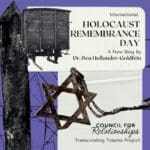
Learn more about the Transcending Trauma Project at Council for Relationships
International Holocaust Remembrance Day and the Mental Health Legacy of the Holocaust
International Holocaust Remembrance Day, commemorated on January 27, 2026—the anniversary of the liberation of the infamous death camp, Auschwitz-Birkenau—is here again. Once again, I have been asked to write about this profoundly sad day in the history of the world and the Jewish people.
I am the child of Holocaust survivors, and I know about the Holocaust. I know the experiences of my parents and their families. I have studied the formal history of the Holocaust, and I direct the Transcending Trauma Project, which has conducted 307 psychosocial life histories of 91 survivors, their children, and grandchildren.
World War II, Intergenerational Trauma, and Resilience
World War II ended in Europe on May 8, 1945, and ended in Japan on August 15, 1945. It has been 81 years since the end of the Holocaust, and there is an extensive mental health literature about the psychological challenges of survivors, their children, their grandchildren, and more recently writings about their great-grandchildren.
Research investigations over the decades have set the standard for the study of post-traumatic impact for individuals, families, and communities that have suffered discrimination, dehumanization, death, and forced relocation. These past investigations form the foundation for the ongoing study of trauma and resilience.
“Never Again,” Moral Responsibility, and the Psychology of Bystanders
After World War II, the shock of the unbridled cruelty of the Nazi regime created a new consciousness of the potential of hatred—a hatred that can decimate communities within society if not stopped by political structures and by human society itself.
After World War II, the catchphrase was “NEVER AGAIN.” Winston Churchill, in 1948, rephrased the popular quote from Santayana: “Those that fail to learn from history are doomed to repeat it.” So how do we learn?
In the United States, there was a concerted attempt to learn from the Holocaust through public memorial gatherings, permanent memorial statues, museum exhibitions, the establishment of the US Holocaust Memorial Museum in Washington, D.C., required school curricula, graduate programs in Holocaust studies, documentary and historical films, public speaking by survivors in varied public settings including the Philadelphia public school system, contests for students to represent the Holocaust through art and writing, etc., etc. You get the picture.
The goals were memorial, but also to know about the genocide called the Holocaust so that we do not repeat the genocidal insanity of Hitler’s plan to destroy the Jewish people worldwide and make the Aryan nation the rulers of the world. One cannot be vigilant to fulfill this compelling objective of never again without knowing what happened.
Therefore, educating American society about the Holocaust is about the survival of society in a long-term sense. Observers of history know that when hatred begins with one group, it is inevitable that the hatred spreads to other groups. This was tragically substantiated by the Holocaust. This is captured in the statement by the German pastor Martin Niemöller:
“First they came for the socialists, and I did not speak out—because I was not a socialist.
Then they came for the trade unionists, and I did not speak out—because I was not a trade unionist.
Then they came for the Jews, and I did not speak out—because I was not a Jew.
Then they came for me—and there was no one left to speak for me.”
After World War II, Reverend Niemöller openly spoke about his own early complicity in Nazism, his eventual incarceration in a concentration camp, and his guilty confession of succumbing to hate.
When I was growing up, this quote was often referred to. But I have not heard it recently. I bring it to you to think about its meaning. The importance of this statement is becoming an imperative in today’s world. Open your heart and listen well to this call for a sense of personal responsibility for what we see as injustice in the world today.
A Survivor Family Perspective: Identity, Integration, and Hope
When I was growing up in America, in New York City, as a child of survivors born in 1951, I grew up in a mixed economic community—yes, predominantly white—right next to a Black community. I attended a school with an integrated student body. Yes, it was the era of integration and this was part of the news on a daily basis and the daily discourse. That should give you a hint of my consciousness as a child.
I saw the West as having learned the devastating lessons of the Holocaust and that it was moving toward a more progressive, egalitarian society, and I saw myself as part of it. For me the movement toward a more progressive, egalitarian society was a postwar reality and would never be reversed because we had learned, to our bones, the lethality of hatred.
I was at City College in Manhattan and participated in the college protests, spearheaded by Columbia University, advocating for equal rights for the Black community and against the war in Vietnam. I also went to Washington, D.C. to protest for Soviet Jewry who wanted to leave Russia for the sake of religious freedom. When the protests were met with the willingness of college administration to work together, I was part of a student committee working on establishing Black Studies, Jewish Studies, Hispanic Studies, and Women’s Studies departments. Sensitivity to sexual diversity and equality would come later. When I moved on to the doctoral program in psychology at Teachers College, Columbia University, the struggle for equal rights had become assumptive.
Fast forward, I was among the volunteers at the Council for Relationships to form REWG, the Racial Equity Working Group, after the killing of George Floyd in 2020, to continue working for racial equality. I also advocated for DEIAB as an organizational standard at CFR.
Disillusionment, Coping, and Choosing Connection Over Apathy
So when forces in society began to reverse the forward movement of equality, I was shocked and devastated. That is when I earned the title of Unicorn. I was seen as naïve in my perception of the world as progressive and committed to equality. I was unwilling, if not unable, to recognize the signs of regressive movement in society.
One way I coped with the reality of the Holocaust was to see the United States as contributing to a better world. I could not see it any other way. Now that reality has bashed me on the head, I look back and acknowledge that I still would have rather been a unicorn than apathetic, disillusioned, disconnected and unaffiliated.
So what is my point? We cannot stop knowing what happened during the Holocaust and recognizing other oppressions in our society. If we do not know we will repeat the hatreds of the past or be the bystanders who are swept up by societal forces. The people who do not do anything.
A Mental Health Concern: What Happens When Knowledge Fades
I was very upset to read that research shows that there is less general knowledge about the Holocaust, especially among teenagers and young adults. They are the fourth generation since the Holocaust. Does this mean that we are condemned to relive the past?
A Fourth-Generation Witnessing Trip: Memory, Meaning, and Direction
Last winter I was hanging out with my family and I noticed that my young adult granddaughter was somehow unclear of her future and did not have a sense of direction. Social stuff was primary which is normal. I asked her if she wanted to go to Poland with me on a tour of the Holocaust sites and the remnants of the Jewish community. I wanted her to not just know the past but to also feel it. She readily agreed so we made plans to go in March 2025. She worked it out with college and we embarked on an emotionally heavy and meaningful trip back to Poland which is where her great-grandparents came from. In 1939 Germany conquered Poland and built the industry of destruction called the concentration and death camps.
She had her phone and kept in touch with her friends but each day compelled her to go back in time and feel the pain of millions destroyed in the Holocaust. Eleven million lives were destroyed by the Nazi killing machine—not to mention the soldiers lost in battle. She was touched, and the history that she learned in her Jewish Day School came to life.
We walked together, often holding each other while listening to the history shared by the tour guide. I felt her as we sat silently on the bus going from the sites of death camps to the ruins of synagogues.
After the Holocaust: Loss, Survival, and the Remnants of Community
We went to a synagogue in Warsaw which was re-established through charitable donations after the war. It was very special to be there to see that there was access to Jewish expression for those Jews still in Poland. It feels overwhelmingly unbelievable that there were 440 synagogues that existed in Warsaw before the war. 440 is only a number but the decimation of the Jewish community in Poland is a devastating reality.
In the area that was the center of the Jewish community in Lviv, Poland there is a central park with boutique shops and cafes that surround the square. The restaurants still have the Jewish art on the walls from before the war. Tour groups bear witness to the art but the customers do not know their historical meaning and value. The flea market stalls that surround the central square sell Jewish spiritual items as trinkets. We saw other tour groups come through who were not sponsored by Jewish auspices. This was a source of comfort.
Learning, Empathy, and Taking Action to Reduce Harm
Go out and learn so that you can know. Learn about the Holocaust, learn about racism, learn about prejudice, learn about poverty, learn about seeking asylum, learn about those who are ostracized in our world. Learn so that you know what not to do, as shared by Reverend Niemöller. Know the past so that you can improve the present and build a better future.
Be vigilant about the equality of human life and fight hatred. Count life’s blessings and recognize the imperative to contribute to a positive society. My granddaughter is the fourth generation since the Holocaust. Far enough away to forget. This trip made the Holocaust real. When she figures out the choices for her future and figures out the social world, I hope there will be a part of her that is always aware of her role in the world beyond her own—that she is a witness.
Remembrance, Education, and Moral Responsibility
Hear the words of introduction for a Holocaust survivor at a recent Holocaust memorial event. Sarah Meller “reminds us not only of the atrocities of the Holocaust, but of the strength of the human spirit, and the importance of remembrance, education and moral responsibility”.
Trauma-Informed Therapy and Healing Resources at Council for Relationships
The sections below offer a few ways to stay connected to trauma-informed mental health resources, support this work, and take a next step toward care.
Transcending Trauma Project: Intergenerational Trauma Research and How to Support the Work
The Transcending Trauma Project (TTP) explores how people and families live with the impact of extreme trauma, and how coping and resilience can move across generations. Readers who want to learn more about the project can visit the TTP page. If this work resonates, a donation helps sustain the interviews, archival work, and public education that keep these stories accessible and meaningful. Readers who would like ongoing updates can also sign up for the TTP email list, so they can stay connected to new posts, project news, and opportunities to engage.
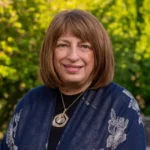
Dr. Bea Hollander-Goldfein, LMFT, CCTP,APIT | Staff Therapist & Director of the Transcending Trauma Project
About the Author: Dr. Bea Hollander-Goldfein
Bea Hollander-Goldfein, PhD, LMFT, CCTP, APIT, is a Staff Therapist at Council for Relationships and the Director of the Transcending Trauma Project. Readers can learn more about Dr. Hollander-Goldfein’s clinical approach and areas of focus on her therapist bio page. For those who are seeking trauma-informed therapy or relationship support, Council for Relationships offers expert care from a team of clinicians, and getting started can begin with exploring therapy options through CFR’s website.
More Mental Health Support from Council for Relationships: Newsletters, Blogs, and Low-Fee Therapy
Council for Relationships shares practical mental health resources through newsletters and blog content, and donations help expand access to care through low-fee therapy services. Readers who want mental health insights and updates can sign up for CFR newsletters, and those who want to keep reading can explore additional blog posts. If you believe therapy should be accessible when life feels heavy, a gift to support low-fee services helps more people get the care they need, with dignity and respect, even when cost is a barrier.
Holocaust Remembrance & the Legacy of Intergenerational Trauma
Combatting Rising Antisemitism & Racism this International Holocaust Memorial Day