
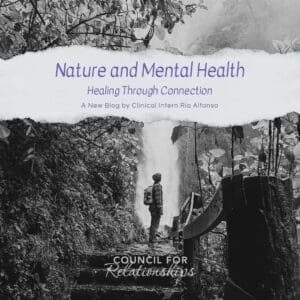
Nature and Mental Health: Healing Through Connection
Council for Relationships understands that nature and mental health are deeply connected, but that connection is not experienced equally. For many people, time in nature can support grounding, stress relief, and emotional well-being. At the same time, history, access, safety, and systemic inequities all shape what it means to connect with the natural world. This blog by CFR Clinical Intern Ria Alfonso explores how nature and mental health intersect, why that relationship can feel complicated, and how people can begin building a more meaningful connection with the world around them.
Get matched with a CFR therapist for relationship-centered care.
Nature and Mental Health: What Nature Teaches Us About Diversity and Relationships
In the natural world, the healthiest and most resilient environments are often those with the greatest biodiversity. In much the same way, diversity in relationships helps make a community healthy, generative, and resilient.
Beyond offering a model for healthy communities, nature has long been understood to have healing properties. However, the history of this nation makes the idea of connecting with nature more complicated than it might seem.
In this blog, I explore both the benefits of and barriers to connecting with nature. I also offer ideas about what it means to relate to nature, and why that connection might matter, even if you do not consider yourself a “nature person.”
Benefits of Nature for Mental Health
Research demonstrates significant somatic and psychological benefits associated with time spent in nature, including reduced hypertension, lower cortisol levels, decreased sympathetic nervous system activity, and relief from depression and anxiety. Grounding, defined here as making direct or sensory connections with the natural world, can reduce chronic inflammation, pain, and stress while improving sleep and blood flow. Additional studies on vitality suggest that even indirect engagement, such as viewing images of nature or journaling about outdoor experiences, can improve mood, attention, and an overall sense of aliveness.
Although there is a wealth of information showing that nature and connection to land can support physical and mental well-being, much of this narrative misses an important piece: what makes that connection more or less accessible for different people, and what does it even mean to “connect with nature”?
Why Nature Can Feel Inaccessible
Access to land and natural spaces has been systematically restricted, stolen, or made unsafe for Black, Indigenous, and other marginalized communities through colonization, enslavement, redlining, and ongoing environmental racism. Although access to natural resources has long been shaped by federal policies and actions, Indigenous communities have faced dispossession, forced removal, and ongoing barriers to land and natural resources. Sacred sites have also been threatened, and Indigenous sovereignty has been undermined. People of color continue to face intimidation, surveillance, and violence in green spaces.
Given this history, it is not surprising that contemporary healing modalities centered on nature connection and land-based practices can feel overwhelmingly white. The way research, and much of the mental health field, discusses nature often overlooks this nation’s complex relationship with land. If being told to spend time outside feels out of touch, inaccessible, or simply unpleasant, that is not a personal failing.
The “Nature Gap” refers to the uneven and inequitable distribution of forests, streams, wetlands, and other intact natural spaces. Data analyzed by Conservation Science Partners offers important insight into how this history has contributed to disparities in access and relationship. Seventy-four percent of people living in nature-deprived areas are people of color, meaning that communities of color are three times more likely than white communities to live in nature-deprived areas.
How are people supposed to feel connected to the plant and animal life in their communities when they are systematically denied that access? Although the full depth of this research is beyond the scope of this blog post, it offers important context for understanding why “connecting with nature” is not a neutral act and is not experienced in the same way by everyone.
Nature and Mental Health Through Indigenous Relationships with Land
While access to land has been restricted for some communities, these historical and ongoing realities have shaped everyone’s relationship with nature. This history of colonization and discrimination has not only made nature less accessible, but has also shaped and, at times, distorted what it means to connect with it.
Many Indigenous worldviews understand wellness as a balance among mind, body, spirit, community, and land. Recognizing that our relationship with the planet is intertwined with our own healing can deepen our sense of community and belonging. From this perspective, healing, especially from historical and intergenerational trauma, is closely tied to restoring relationships with the land.
Wellness culture can sometimes make it seem as though connecting with nature requires time, money, and a particular kind of spirituality. Yet a relationship with the natural world does not mean returning to an idealized version of nature or forcing ourselves into spaces that feel unsafe or uncomfortable. It can take many forms and is not limited to long hikes or overseas retreats. Although access to long periods of time in quiet green spaces is certainly a luxury, that is not the only way to have a relationship with nature.
Instead, it can begin with becoming more aware of the relationships we are already in. Nature is with us all the time: the air we breathe, the water we drink, and the ground we walk on. These are not abstractions, but ongoing relationships that sustain us whether we acknowledge them or not. Taking time to notice how you are already interacting with the natural world in your daily life is a meaningful place to start. When we understand the more-than-human world as part of our relational network, not as a resource or backdrop but as kin, we expand the systems of support available to us.
While integrating Indigenous worldviews into Western practices must be approached with care, humility, and accountability, it is also important not to assume that only Indigenous communities are responsible for repairing this relationship. That assumption allows others to remain disconnected and continues a colonial pattern of overlooking the knowledge of those who have stewarded this land for millennia.
Simple Ways to Support Nature and Mental Health Right Now
While broader efforts are needed to invest in green spaces in communities of color and to shift policies that restore access to natural spaces for Indigenous communities, there are also steps you can take right now to begin building this connection for yourself.
For many people, some level of connection remains available.
The skills often cultivated in therapy, such as self-reflection, curiosity, accountability, and compassion, can serve as guides for reconnecting with the natural world as a relational partner rather than something to control, consume, or use only for coping.
This does not have to be dramatic. It can be slow. It can be simple. And it can happen in ways that feel safe and accessible. The benefits of nature are not limited to long hikes in the so-called wilderness or expensive retreats in faraway places. This connection can begin by putting your feet on the ground exactly where you are and considering what that relationship might mean for you.
Building a relationship with nature does not have to be expensive, time-consuming, or far from home. Here are a few accessible ways to begin noticing, honoring, and deepening that connection in everyday life:
- Learn about and support the people Indigenous to this area, including the Lenape Nation of Pennsylvania.
- Notice the trees and plants in your neighborhood. Learn their names and pay attention to them often. Yes, the weeds in the concrete count.
- Find a way to connect with the earth, even if only for one minute.
- Give a nod to the Delaware River and the Schuylkill River when you take a shower or brush your teeth. This is where our water comes from.
- Take a moment to notice sunlight, warmth, or fresh air and give thanks.
- Join a local Love Your Park clean-up day to care for the green spaces near you.
- Look up images of nature and notice which landscapes feel interesting to you.
- Pay attention to how the seasons make you feel in your body.
- Contemplate this quote from author Lewis Dartnell:
“The water in your body once flowed down the Nile, fell as monsoon rain onto India, and swirled through the Pacific. The carbon in your cells was drawn from the air by ancient plants. The salt in your sweat and tears, the calcium in your bones, and the iron in your blood were eroded from Earth’s crust. The sulfur in your muscles rose from volcanoes. At every moment, you are held by, shaped by, and connected to the world around you.”
- If you are interested in spending time in nature in ways that feel more accessible and culturally affirming, resources are available. Organizations like Latino Outdoors and Outdoor Afro emphasize the cultural importance and many health benefits of spending time outside while actively expanding access and representation in outdoor spaces. This list offers 60+ organizations that center diversity and inclusion in outdoor spaces.
Reconnecting with nature does not need to start with a grand gesture. It can start with noticing what is already around you and allowing that relationship to become one more source of grounding, belonging, and care in your life.
Nature and Mental Health at Council for Relationships
At Council for Relationships, the connection between nature and mental health makes sense within a larger systemic view of healing. People do not exist apart from their relationships, communities, or environments, and therapy should reflect that reality. CFR’s approach to care recognizes that emotional well-being is shaped not only by what happens within a person, but also by the broader systems and relationships that surround them. In that way, this blog’s focus on connection, access, and belonging reflects the same relational understanding that guides care at CFR.

Ria Alfonso is a Council for Relationships Clinical Intern.
Clinical Internship Program & Diversity Scholarship
This blog was written by CFR Clinical Intern Ria Alfonso, a recipient of CFR’s Diversity Scholarship for Emerging Clinicians. Through CFR’s Clinical Internship Program, emerging therapists gain hands-on experience while helping expand access to care in the communities they serve. The Diversity Scholarship supports clinicians from historically marginalized backgrounds as they complete their training and helps address barriers to access within the mental health field. Learn more about CFR’s Clinical Internship Program or support future Diversity Scholarships by donating to CFR.
More Council for Relationships Resources on Nature and Mental Health
For many people, concerns related to nature and mental health connect to larger experiences of stress, trauma, life transitions, and relationships. CFR offers therapy and psychiatry for individuals, couples, families, and other relationships. With a systemic approach at the center of care, CFR helps people understand themselves in the context of the relationships and environments that shape their lives. CFR’s team offers care grounded in connection, collaboration, and lasting change.
More from Council for Relationships
Looking for more from CFR? Explore the blog for additional mental health insights, sign up for a newsletter to stay connected, or support CFR’s mission with a donation. Every action helps strengthen access to expert care, community-based healing, and training for the next generation of therapists. If this blog on nature and mental health resonated, there is more to discover through CFR’s therapy resources, educational content, and ongoing community work.
Supporting Transgender Mental Health Through Gender Affirming Care
Community Care as Revolutionary Self-Care: Mental Health & Community in Practice